

The False Nine: Football’s Most Subtle Revolution
From Nándor Hidegkuti to Lionel Messi: how the striker disappeared and reshaped the game


Before football learned how to bend space, it was obsessed with occupying it.
For decades, the striker was a fixed point; a reference marker around which everything else revolved: they stood on the last line, battled centre-backs, attacked crosses, and finished moves. The role was simple, physical, and brutally clear.
Then, slowly, almost quietly, something changed. The striker began to disappear. Not literally, but positionally, conceptually and structurally. The person who was supposed to lead the line started stepping away from it, dropping deeper, drifting wider and refusing to be where the game expected him to be.
In doing so, they didn’t just alter their own role, they destabilised the entire system.
This is the story of the false nine, football’s most elegant act of disruption, and how it evolved from a tactical curiosity into one of the defining ideas of the modern game.
Before the False Nine: The Tyranny of Position
To understand the false nine, you need to understand what came before it.
For much of football’s early history, formations were rigid. Systems like the 2-3-5 and later the WM formation assigned players clear zones and responsibilities. The centre-forward, the “number nine” was expected to stay high, occupy defenders, and finish attacks.
The logic was straightforward and deeply ingrained: defenders marked attackers, attackers stayed in their lanes, and space was something to be fought over rather than shaped. Of course, movement existed, but it rarely broke the underlying structure of the system.
The striker’s role was not to confuse the defence, but to confront it directly. That rigidity created stability, but it also created predictability, and predictability, in football, is an invitation to find loopholes.
The First Cracks: G.O. Smith & Nándor Hidegkuti
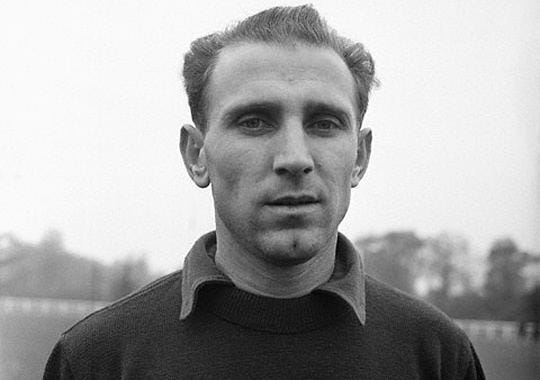
It’s said that the false nine was first used by Corinthians in the late 1890s, where English centre-forward G.O. Smith preferred to supply the wingers with through balls and create, rather than stay as high up as possible on the pitch, which, att the time, was a revolutionary tactical shift.
However, the first true glimpse of the false nine came in the 1950s, through the revolutionary Hungarian national team aka the Mighty Magyars. At the centre of that innovation was Nándor Hidegkuti, a player who quietly dismantled one of football’s most fundamental assumptions.
Hidegkuti refused to behave like a striker. Rather than occupying the defensive line, he repeatedly dropped into midfield, pulling defenders with him and distorting the opposition’s structure.
This created a dilemma that defenders of the time weren’t equipped to solve. If they followed him, they left space behind, but if they held their position, they allowed him time and freedom between the lines.
England encountered this problem brutally in 1953, when Hungary defeated them 6–3 at Wembley. Hidegkuti scored a hat-trick, but the real significance of the performance lay in the confusion he created. England’s defenders were not just beaten; they were disoriented.
By vacating the forward line, Hidegkuti did something radical: he turned absence into a weapon.
Total Football: Johan Cruyff
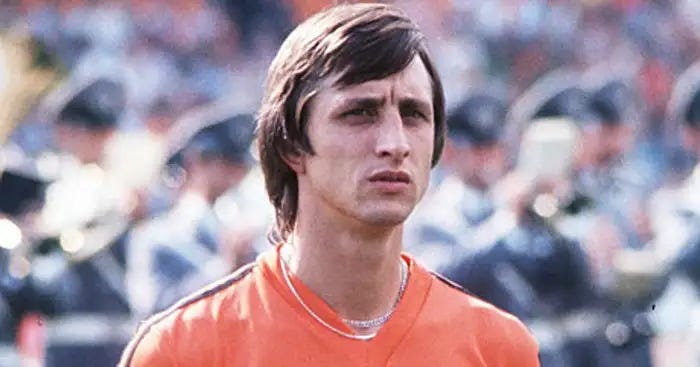
If Hungary exposed the weakness in football’s structure, the Netherlands national football team expanded it into a philosophy.
In the 1970s, Johan Cruyff became the face of Total Football, a system developed by Rinus Michaels that rejected fixed positions in favour of constant movement and interchange. Players were no longer defined by where they started, but by how they interpreted space.
Within this framework, the traditional number nine began to dissolve. Cruyff himself often operated as a kind of roaming forward, dropping into midfield, drifting wide, and appearing wherever the game required him, but more importantly, his movement was part of a collective understanding shared across the team.
Total Football was not about one player disrupting the system, it was about the system itself becoming fluid. In that environment, the false nine ceased to be a role and became something more abstract; a principle embedded within the game itself. Positions were no longer fixed, space was no longer owned, and movement became the dominant language of football.
Cruyff did not invent the false nine, but he made it unavoidable.
The Italian Interpretation: Francesco Totti

For many years, Italian football was associated with defensive structure and tactical discipline. Yet in the early 2000s, a quieter evolution took place in Rome.
Under Luciano Spalletti at AS Roma, Francesco Totti was reimagined.
No longer a conventional forward, Totti began to operate deeper, acting as both creator and focal point. He drifted into midfield, dictated play, and allowed runners from wide and deeper positions to attack the space he left behind.
This was not improvisation, it was deliberate. By removing the striker from the defensive line, Roma forced opponents into a series of uncomfortable decisions. Defensive structures built on clarity suddenly had to deal with ambiguity.
Totti did not overwhelm opponents with pace or movement, he dismantled them with intelligence. In doing so, he demonstrated that the false nine could function not just as an idea, but as a repeatable tactical system.
The Modern Evolution: Lionel Messi

If the false nine had been evolving quietly for decades, it exploded into global consciousness with Lionel Messi at Barcelona under Pep Guardiola. This was the moment the concept reached its purest and most devastating form.
Guardiola’s decision to move Messi centrally, but not as a traditional striker, fundamentally altered how opponents defended Barcelona. When Messi dropped into midfield, defenders were forced into hesitation. If they followed him, they broke their own structure. If they stayed, they gave him time on the ball in the most dangerous areas of the pitch.
Around him, Barcelona’s system amplified the chaos. Wide players attacked the space behind the defence, midfielders controlled possession, and Messi himself became both creator and finisher.
What made this version of the false nine unique was not just its structure, but the player executing it. Messi did not simply interpret the role, he expanded it. He could receive deep, eliminate defenders with a dribble, and still arrive in the box to finish moves. He could orchestrate play and end it. He could create order and exploit disorder in the same sequence.
For a brief period, it felt as though football had been solved.
Why the False Nine Works
At its core, the false nine is not about position, but about uncertainty.
Defensive systems rely on clarity; they depend on knowing who to mark, when to step out, and how to maintain shape, but the false nine introduces doubt into each of those decisions.
When the central forward leaves the line, the defence is forced to interpret rather than react. Every choice carries risk; following creates space, holding creates time, and passing responsibility introduces confusion.
The role does not just create space, it creates hesitation, and at the highest level of football, hesitation is often the difference between control and collapse.
The Counter-Reaction
Given its effectiveness, the false nine might have been expected to dominate the modern game, but it didn’t.
Part of the reason lies in the rarity of players capable of executing the role at the highest level. The false nine demands a blend of technical ability, intelligence, and composure that few players possess.
At the same time however, defensive structures evolved. Centre-backs became more comfortable operating in space, and teams developed systems better equipped to handle positional fluidity.
Football did not reject the false nine, it adapted to it, as it always does.
The Modern Echo

Today, the false nine rarely appears in its pure form, but its influence is everywhere. Players like Roberto Firmino, Harry Kane, and Karim Benzema operate in hybrid roles that carry its DNA. They drop deep, link play, and blur the boundaries between striker and midfielder.
The idea has outgrown the position, and what began as a tactical disruption has become a fundamental part of how modern football understands movement, space, and control.
The Disappearing Striker
The false nine did something quietly radical: it removed the one player everyone assumed had to exist.
For over a century, football had been built around the presence of a striker. The role was fixed, unquestioned, almost sacred, but the false nine challenged that assumption. It suggested that the game did not require a striker to function, only the idea of one.
And once that idea was loosened, everything else began to shift.
What Comes Next

The story of the false nine is not just about tactics, it’s about how football evolves when someone questions its most basic rules:
Hidegkuti stepped away from the defensive line and created confusion.
Cruyff dissolved positions entirely.
Totti redefined the forward as a playmaker.
Messi turned the role into something that felt almost unreal.
Each of them revealed something deeper about the game:
That its structure is not fixed, rules are not permanent, and what looks stable is often only agreed upon.
In a few days time in The Kit Room, we’ll take that idea even further with another article, because once you start to see football not just as a game, but as a system: a set of patterns, movements, and invisible relationships, a different question begins to emerge. Not just how the game is played, but whether some players are seeing something the rest of us aren’t.
Stay tuned…
THE KIT ROOM
Who was the first player that made you realise a striker didn't’t have to be a striker?